November 3, 2023 7:00 am

The Science of Math Instruction: Incorporating Research-Based Instruction into Technology

Everyone’s talking about the science of reading, but what about mathematics? Take a look at agreed-upon best practices called cognitively-guided instruction, as well as technology that puts it into practice.

Teaching mathematics means more than introducing algorithms and procedures to students. Research shows that effective instruction also involves the development of a student’s conceptual understanding, mathematical reasoning, and problem-solving skills.

One research-based approach to mathematics instruction is Cognitively Guided Instruction (CGI), as described in Children’s Mathematics: Cognitively Guided Instruction (Carpenter et al., 2014). CGI shifts an educator’s focus away from direct instruction and toward understanding an individual student’s mathematical thinking. The teacher then leverages this understanding as the foundation to guide the student toward increasingly complex concepts.

Now, as online programs gain popularity in today’s classrooms, schools have the opportunity to choose technology that not only supports students’ procedural fluency but also aligns with research-based principles to develop students’ conceptual understanding. By evaluating the technology we bring to students through the lens of a framework such as CGI, we can help ensure that students have the opportunity to develop the skills they need to succeed beyond memorization.

What is Cognitively Guided Instruction (CGI)?

CGI is an approach to teaching mathematics that focuses on students’ critical thinking and problem-solving. Instead of just showing students how to solve a problem, teachers guide students to explore strategies and approaches that make sense from their unique understanding of a situation. The following are just some of the principles of CGI, as highlighted in Children’s Mathematics (Carpenter et al., 2014).   

  • Problem Solving: Students are encouraged to tackle problems using critical thinking and creativity before receiving direct instruction. Given a story problem anchored in a real-world context familiar to students (such as sharing a food item among friends), students reason using a strategy of their choice.
  • Teacher as a Facilitator: Teachers transition away from the role of traditional instructors and toward the role of facilitators. They listen to students’ strategies, pose thought-provoking questions, and steer discussions while providing opportunities for students to learn from their peers’ thought processes.
  • Building on Prior Knowledge: Students bring their experiences and understandings into the classroom. Teachers leverage each student’s prior knowledge as a foundation and layer new concepts on top of the ideas that students have already grasped.
student solving math equation

Applying CGI to Online Learning

When designed with research-based principles in mind, online programs have the ability to increase accessibility to effective instruction. For example, the following characteristics of various online programs provide the flexibility to support CGI practices.

  • Adaptive Learning Environments: Adaptive learning environments powered by algorithms can provide students with a personalized learning experience that caters to their unique needs and preferences. By analyzing a student’s performance and feedback, online platforms can generate customized content tailored to their strengths and weaknesses. This approach to learning aligns with CGI’s emphasis on personalized education, which recognizes that every student has a unique learning style and pace.
  • Virtual Manipulatives: Utilizing virtual tools, such as base-ten blocks, offers students an interactive experience to experiment with variables and visualize outcomes. This approach enables them to select the appropriate device that aligns with their current understanding and apply critical thinking and creativity to solve a given problem.
  • Real-world Problem Solving: Online platforms can offer practical problem-solving exercises that mirror real-life challenges. This approach aligns with cognitively guided instruction’s emphasis on applying mathematical concepts to everyday situations. By bridging the gap between theory and practical significance, students can gain a deeper, contextual understanding of mathematics and its relation to the world around them.

By incorporating CGI practices with online platforms’ capabilities, we can anchor each student’s learning experience in student-centered, data-driven instruction.

The Idaho Study: A Snapshot of Research-Based Technology in Action

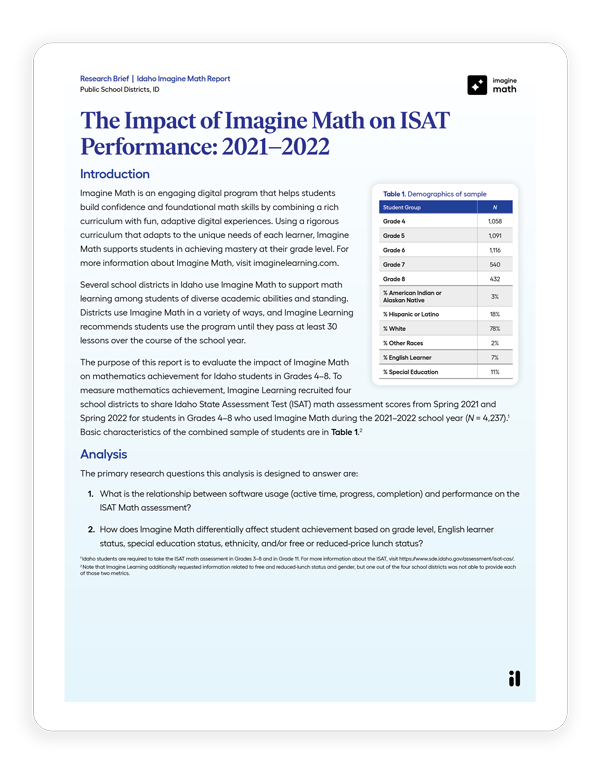
Imagine Math ISAT Performance Research Brief
Read the Full Study

Imagine Math is one supplemental, personalized online program that incorporates the features highlighted above. It presents students with problems, equips them with virtual tools, and adapts its levels of support in response to students’ answers. “Imagine Math’s personalized learning platform aligns with each student’s needs while providing the right amount of challenge to help the student achieve grade-level proficiency,” said Sari Factor, Chief Strategy Officer at Imagine Learning (New Study Reveals Significant Gains in Student Math Performance with Imagine Math, 2023).

This year, a study was conducted to assess the impact of Imagine Math on students’ academic performance. The study analyzed over 4,000 math assessment scores from the Idaho State Assessment Test (ISAT) of students in grades 4 through 8. The assessment scores were taken from schools across four different districts in Idaho during the 2021-22 academic year. Key takeaways from the research include:

  • The relationship between Imagine Math lessons passed, and ISAT score growth is positive for all grades and statistically significant for grades 4 through 7.
  • Positive and significant relationships between Imagine Math lessons passed and ISAT math score growth for various student subgroups, including special education students, English learners, students eligible for free or reduced-price lunch, and Hispanic/Latino or American Indian/Alaskan Native students.

These findings underscore the potential of platforms like Imagine Math that align with student-centered methodologies to enhance student outcomes.

The Future of Math Instruction

In today’s rapidly evolving society, education has significantly shifted due to technological advancements and a more comprehensive understanding of how individual students learn. By leveraging technology that incorporates research-based instruction, educators can create a more engaging and effective learning experience for students, leading to better academic outcomes and a more promising future.

About the Author – Erin Springer

Erin Springer is a former elementary school teacher who transitioned to supporting other teachers as a Professional Development Specialist at Imagine Learning. She is enthusiastic about helping teachers use educational technology to improve student outcomes, save time, and understand students’ needs.

Citations:

Carpenter, T. P., Fennema, E., Franke, M. L., Levi, L., & Empson, S. B. (2014). Children’s Mathematics: Cognitively Guided Instruction (2nd ed.). Heinemann.

Imagine Learning. (2023, June 20). New Study Reveals Significant Gains in Student Math Performance with Imagine Math [Press release]. https://www.imaginelearning.com/press/study-reveals-significant-gains-student-math-performance-imagine-math/

September 7, 2023 10:21 am

Soft Skills with Big Impact: the 4Cs of STEM

Make STEM classrooms a playground for curiosity, a canvas for creativity, a stage for communication, and a hub for collaboration. When students embrace these skills, they’re not just preparing for the future — they’re shaping it.

“Hey Siri, how many rings does Saturn have?”

“Alexa, tell me what the square root of 1089?”

“ChatGPT: give me HTML code to embed a basic calculator on a webpage.”

There was a day when students had to ask their teachers, librarians, or even consult an encyclopedia for this type of information. But those days are long (like really long) gone, and the teacher is no longer the only keeper of information in the room.

Since the teacher’s role is evolving due to new technologies, and certainly students are not motivated to memorize what Alexa already knows, what should STEM classrooms be focused on? What skills are employers in STEM careers looking for if ChatGPT can produce code for free?

A 2018 survey by the Association of American Colleges & Universities showed, “that just 34 percent of top executives and 25 percent of hiring managers say students have the skills to be promoted. Many of those skills are soft skills — communication, team work, problem-solving — that are critical in a quickly shifting job market. Entry-level skills change every few years; it’s the habits of learning to learn and navigating the ambiguity of a career that will prove most valuable to undergraduates in the long run.”

The National Education Association has boiled these soft skills down to the 4 Cs: Creativity, Critical Thinking, Communication, and Collaboration. Let’s explore why these 4Cs are critical to providing a modern STEM education that gives students real career opportunities.

1. Critical Thinking: where curiosity begins

Imagine a classroom buzzing with questions. Except, not fact-based “how many rings does Saturn have” questions. Questions like: is it possible for New York City to become carbon neutral? What would that plan look like? Or: why does the kind of water (fresh or salt) affect how long it takes an ice cube to melt? That’s the power of critical thinking at work. It’s all about encouraging young minds to ask, “Why?” and “How?” Critical thinkers don’t just accept things at face value; they dig deeper. When students learn to analyze information, separate facts from opinions, and spot patterns, they become problem-solving heroes.

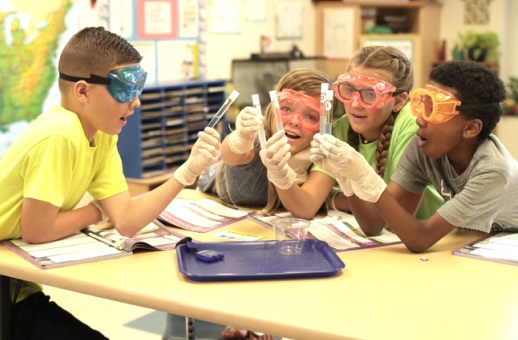
Picture a group of students exploring a science experiment. Instead of just following a set of instructions, they’re asking themselves, “What will happen if we change this variable?” That’s critical thinking igniting their imagination — it’s like a spark that lights up their learning journey.

2. Creativity: where imagination takes flight

Creativity isn’t just for artists — it’s a skill that every STEM student needs. It’s about looking at a problem from a different angle and dreaming up new solutions. Think of it as the magic wand that turns ordinary ideas into extraordinary ones.

Take a moment to think about a famous inventor, like Thomas Edison. He didn’t just stumble upon the light bulb; it took him 1000 attempts to find a design that worked. Creativity is what made him keep going, even when things got tough. Encouraging our students to think outside the box, to come up with wild ideas, and to believe that they can change the world — that’s the heart of creativity in STEM education.

3. Communication: bridges between minds

Imagine a world where nobody understood each other. It would be chaotic, right? Communication is like a bridge that connects our thoughts to the world. In STEM, it’s not enough to have brilliant ideas; you also need to share them effectively.

Think about a young engineer who designs an amazing new gadget. If they can’t explain how it works to others, their idea might never see the light of day. Teaching students how to express complex ideas in simple terms empowers them to inspire, collaborate, and bring their innovations to life.

4. Collaboration: teamwork for triumph

Remember the saying, “Two heads are better than one”? That’s the spirit of collaboration. In a world where problems are more complex than ever, working together is key. Collaboration is like a puzzle; each piece has its role, and when they come together, they create something amazing.

Think about a group of students working on a science project. Some are great at designing, others excel at research, and a few are natural leaders. When they pool their talents, their project becomes a masterpiece. It’s the same spirit that built the tallest skyscrapers and sent humans to the moon.

Putting the 4Cs into action

Imagine a classroom where students use their critical thinking skills to solve a real-world problem. Maybe they’re designing a water-saving system for their school garden. They brainstorm creative ideas, like using rainwater and self-watering plants. Then, they work as a team to build the system and explain their design to their classmates. These students are embracing the 4Cs in action: critical thinking, creativity, communication, and collaboration.

Empowering educators for success

As educators, you’re the guides on this exciting journey. You hold the keys to nurturing the 4Cs in your students. Encourage them to question, to dream, to share, and to work together. Make STEM education a playground for curiosity, a canvas for creativity, a stage for communication, and a hub for collaboration.

When students embrace these skills, they’re not just preparing for the future — they’re shaping it.

Imagine Learning STEM

Prepare the next generation of STEM leaders with digital and hands-on learning aligned to the 4 Cs.

Tell Me More

About the Author – Carolyn Snell

Carolyn Snell started her career in education teaching first grade in San Bernardino, California. A passion for the way technology and stellar curricula can transform classrooms led her to various jobs in edtech, including at the Orange County Department of Education. Her knack for quippy copy landed her a dream job marketing StudySync—an industry leading ELA digital curriculum. Now, as the Senior Content Marketing Manager for Imagine Learning, Carolyn revels in the opportunity to promote innovative products and ideas that are transforming the educational space for teachers and students.

Improved Search in Imagine Math Pathway Library 

Imagine IM

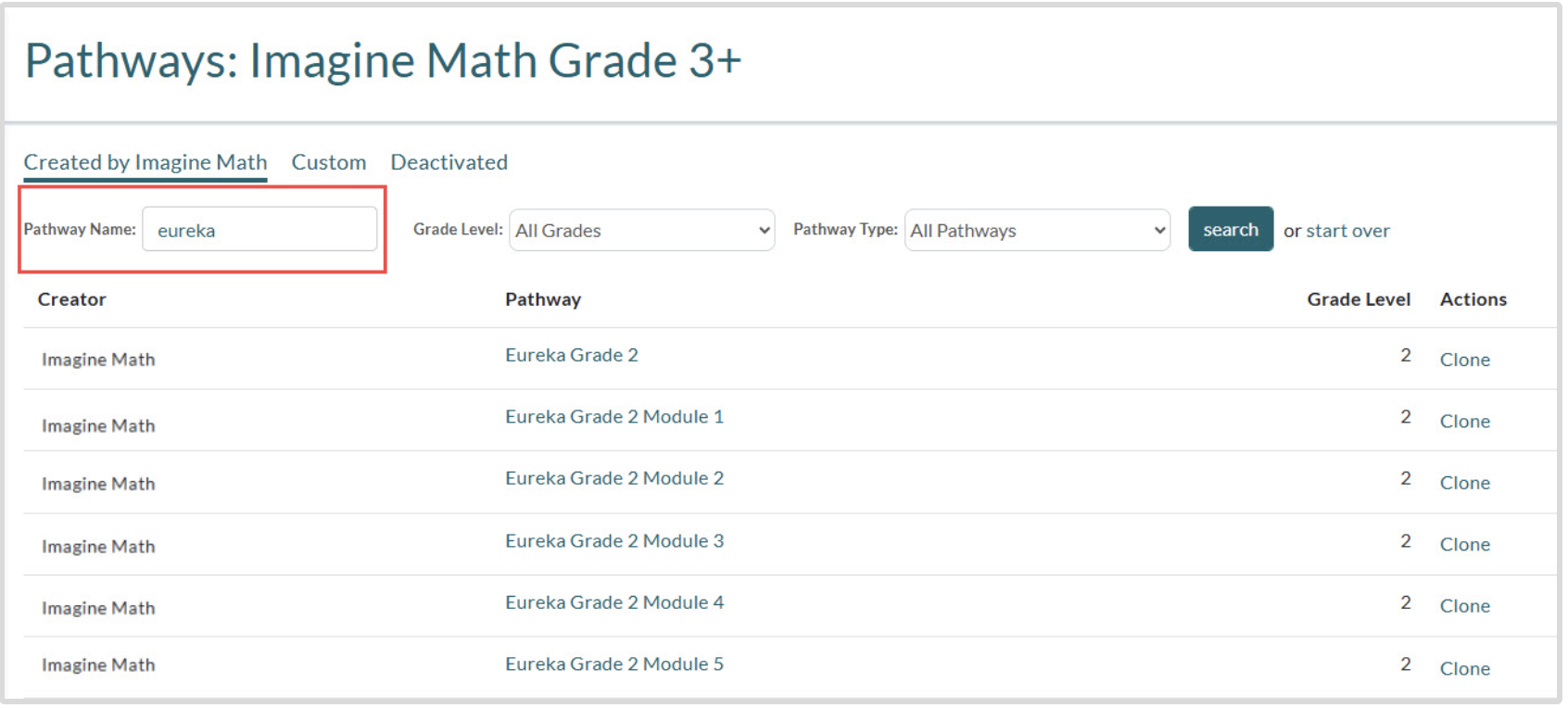
Find learning pathways faster using new “Pathway Name” filter

We’ve expanded the search filters in Imagine Math’s pathway library to include “Pathway Name,” making it easier to find pathways aligned to your core curriculum. Just enter the name of your core program to quickly locate pathways that match its scope and sequence, saving time and improving alignment with instruction. 

Learn More
Imagine Math Pathway name filter

Rewriting a Literacy Crisis

Episode 3: It Takes Time and It Definitely Takes Heart

Back in Pendergast, the ultimate question: Did it work? In this final episode, Lauren returns to the district to find out and speaks with renowned education writer Natalie Wexler on the missing piece in reading instruction. Could the answer have been in front of us all along? Listen and find out.

From Imagine Learning, I’m Lauren Keeling, and you’re listening to Heart Work, an honest profile of America’s educators.

When you care so deeply, you make hard choices, and you do hard things, and you fail forward, and you try again, because that’s what great teachers do. They push forward even when it seems impossible, and they come out on the other end saying, “Whew, that was a wreck, but man, did this go really well! I can’t wait to try both of those things again and see how I can make it even better.”

Every teacher I talked to, every administrator I talked to, every human in those two districts that I spoke with — they weren’t interested in being right; they were really interested in doing right.

It’s been three years since the Pendergast Elementary School District overhauled how they teach reading. In episode one, we saw the shift up close.

A playground map showing Arizona and its neighboring states.

A painted playground map shows Arizona and its neighboring states.

The question now is simple: Did it work? Today, I’ll find out, and I’ll also talk with one of the leading voices in the movement to rethink how we teach reading comprehension.

Natalie Wexler: Let me see if I can start my video now. Yeah, there I am. OK.

My name is Natalie Wexler. I am an education writer. I’ve written a book called The Knowledge Gap — The Hidden Cause of America’s Broken Education System and How to Fix It, and I have a new book coming out in January called Beyond the Science of Reading: Connecting Literacy Instruction to the Science of Learning.

I started writing about education because it seemed incredibly important to me — particularly how we can raise education outcomes for all kids, but also narrow the gap between kids at the upper and lower ends of the socioeconomic spectrum.

Lauren: How did you come to identify the knowledge gap as something that was critical to education?

Natalie: It seemed to me there was a missing piece that could make teachers’ jobs easier and students’ jobs of learning easier as well. The term science of reading has often come to be defined as just more phonics, and it’s way more complicated than that.

There is a lot of scientific evidence related to reading and reading comprehension that should be included in the term science of reading, but it often gets left out. And there are ways in which the standard approach to teaching reading comprehension also conflicts fairly dramatically with what science tells us about how that process works. 

Having knowledge of the topic you’re reading about is really helpful to comprehension, and beyond that, the more general knowledge and vocabulary you have, and particularly more academic kinds of knowledge and vocabulary, the easier it is for you to understand just about anything you try to read. So you become a better general reader with more of that general knowledge.

Natalie’s point echoes what I first learned from her book, The Knowledge Gap, that a lot of students are unfairly disadvantaged because they don’t have adequate background knowledge about certain topics or subjects. And that missing knowledge creates a gap between being able to read the words on a page and actually understanding what those words mean.

That message also resonated with Pendergast’s principal, Mr. Gonzalez. Natalie Wexler’s work helped shift the way he thought about reading — and about how it should be taught.

Mr. Gonzalez: I go back to the research from Natalie Wexler. In her book, she talks about baseball, right? And if we don’t have that background, then how are we going to read a book about baseball?

It’s meaningless to us, right? But if you played baseball and you read other books about baseball, then you’re going to comprehend what you’re reading. The ability to dive deep within that text is so important for comprehension, especially with our students who are English language learners. Really developing those opportunities for students to go back and cite text evidence has really helped us in closing that achievement gap.

Ms. Barrett: We did Basel. We taught Basel. Monday, we did this. Tuesday, we did this. Wednesday, we did this.

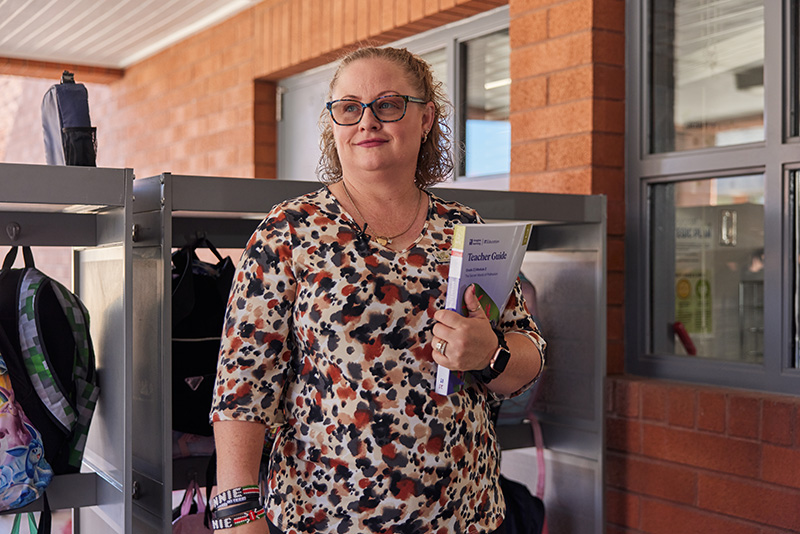
An educator stands out front of her classroom.

Ms. Barrett stands outside her classroom, ready to welcome her students as the day begins.

That’s Ms. Barrett — she teaches second grade and is who we’d call in administration, an early adopter.

Ms. Barrett: Whereas now, it’s not on a five-day schedule. It’s inclusive. It flows from topic to topic. It’s seamless. The kids enjoy it, and it just makes learning a lot more fun.

(Students singing)

Ms. Barrett (to students): Good job, guys. So I want you to go back and look at the poem, OK, and then we’re going to share those out, and then we’re going to talk about it.

Ms. Barrett: When we’re doing our teaching, the first unit is building that background knowledge, but then the modules build on each other, and so a lot of times my kids are taking ownership and they’re taking leadership, and I can step away and I can let them teach.

Lauren: So you get to facilitate?

Ms. Barrett: Right.

Lauren: How does that feel?

Ms. Barrett: It feels really good. Yeah, it feels really good.

There’s this old phrase, “the sage on the stage”. It refers to a teaching style where the teacher delivers information, often through a lecture or presentation, and students are expected to sit, listen, and absorb.

I’m sure we’ve all experienced that at some point in our lives. But in this classroom, there’s no stage. Students are moving around, leaning into the work, excited to be learning. Ms. Barrett is crouched beside a table, asking a question, and really listening to the answer. She’s inviting students to participate in the process of learning, not just leading it.

Natalie: Kids, when they are still learning to decode, the main way they’re going to be acquiring knowledge is not through their own individual reading. It’s going to be through oral language and listening to books being read aloud and talking about the content of those books, using the vocabulary that they’ve just heard in those books, that’s going to transfer that information to long term memory.

Ms. Barrett (to students): Why do they get a scarf for Pat? Hmm, why do they get a scarf for Pat? Because it’s cold and he needs to what?

Student 1: Be warm.

Ms. Barrett: They want to be warm. So what does James — how does it relate back to our reading? To being an independent reader?

Student: I can read in my head.

Ms. Barrett: Oh, you can read in your head? Nice. That’s awesome. Richard?

Student 2: I can read quietly.

Ms. Barrett: You can read quietly.

Student 3: I can read very big words.

Ms. Barrett: You can read very big words.

Natalie: Eventually, when their foundational reading skills catch up to where their background knowledge is, the background knowledge will kick in to enable them to read independently about a range of topics.

Lauren: Do you feel like the children are growing in that space?

Ms. Barrett: Absolutely. They’re growing with their confidence. They’re growing with their communication from peer to peer and from peer to teacher. The kids just love to dive in, and they have become very independent and excited to learn.

I see that independence in the way they talk about their work.

Lauren: So I don’t know what the centers are. Can you explain the centers to me?

Student 1: First, we put up the timer for 15 or 20 minutes, and then we start our centers.

Student 2: There’s a writing one, there’s a reading, there’s goldfish, there’s Ms. Barrett. We have computers. Wherever our names are, we do that center.

Student 3: Like, if we have writing, we just bring our book with us and we write in it.

Student 1: We write about butterflies sometimes and the weekend.

Student 2: When the timer goes off, we switch centers and it keeps going until it’s lunch.

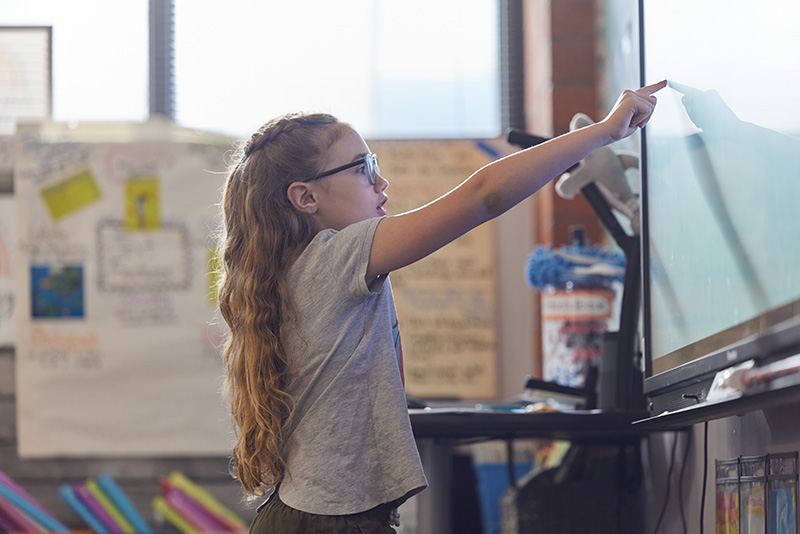
A young student works on a smartboard during a classroom activity.

A young student in Ms. Gabhart’s class works on the smartboard during a classroom activity.

Natalie: Kids get it, and I mean, I’ve been in classrooms where they don’t want the teacher to stop reading. They still have things to say when it’s time for the discussion to end. There’s this excitement in the air. And that is just as much about teaching reading as teaching phonemic awareness and phonics and all of those things that also need to be taught.

Ms. Irvin: In module four in fourth grade, the students have to identify a service project that they’re going to work together on. We spend some time talking about how kids make a difference in their community. They come up with a list of issues they feel that they can impact in their community, and then they start working on a project for that.  

Ms. Irvin tells me about the PSAs her students are creating.  

Ms. Irvin: One year, my kids worked on collecting items for the Phoenix Children’s Hospital, and this year, they have identified our lost and found as a huge problem on our campus. It was overflowing with bags of clothes. And so they are working to get that all organized, get it out to the students so they can start reclaiming their items. We have a whole list of videos and informational text that teaches them about other students and kids who have made a difference in their community, and their end result is that they create a PSA about the results that they had.  

(Student conversation) 

Lauren: Did they get excited about this? Do they love this?  

Ms. Irvin: Oh, they’re very excited about it. They love asking everyday, “Can I go work on the lost and found? I finished my work. Can I go work on lost and found?” And so they’re really involved in it.

Ms. Johnson: So with the PSA, do we need to understand our audience? Okay, so let’s put that on our list as well.

In Ms. Johnson’s seventh-grade class, the PSA’s addressed a global issue: plastic pollution.

The contrast struck me. The fourth graders took on a problem they saw every day. By seventh grade, they had the knowledge and the words to reach further, to connect something global back to their own community.

Student 1: So, should we try to expand this to more than just Avondale, Glendale?

Student 2: Well, if we focus on Avondale, then we could do something that relates to people who live in Arizona?

Student 1: And then — and then build up to make it bigger?

Student 2: And we can bring more awareness to it, yeah.

Student 1: Yeah, good idea.

Student 2: So we’ll focus on recycling, instead of the alternatives?

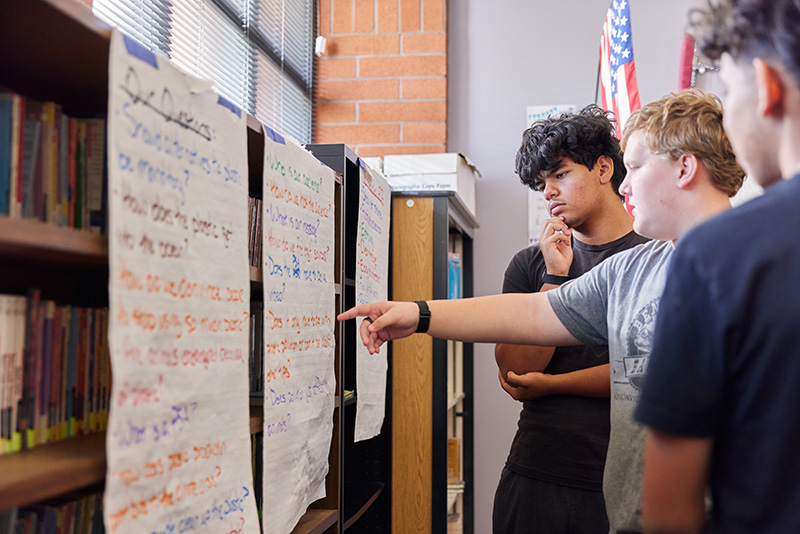
A group of students collaborate in front of handwritten posters.

A group of students collaborate in front of handwritten posters, discussing their ideas during a classroom activity.

Ms. Johnson: I’m starting to see my students bring in ideas and things that they’ve learned in other classes to solidify their statements, and that is a neat thing. Many of them have picked up decoding skills, and their vocabulary has expanded. They’re able to read with better flow. So all of the pieces seem to come together at the end of the school year.

It’s been kind of funny because one of my students wanted an extra recess or something. He made a ten-slide PowerPoint with his argument, stating what he wanted, why he wanted it, and why he felt he could get it. So we did a little negotiating, and it worked. So it was fun. He got an extra recess. And so it was really fun. And that’s the beauty of it, when they start applying those skills that I have taught them.

In Pendergast, the changes seem to be working. And in Philadelphia, I saw what’s possible when educators commit to doing things differently.

Lauren: But, if you were to point to some specific data or some evidence. You know, when your district comes to you and says, “Prove to me that this is working,” how would you do that?

Ms. Irvin: Consistently, I’ve had some of the highest scores in the state reading assessment. My grade level last year, within our own school, had the highest percentage of students passing in all of the grade levels that took it.

Mary: 67% of our kindergarten students showed what was called aggressive growth in their reading at the winter benchmark.

Carina: And we’re anticipating it being higher here at our spring benchmark.

Ms. Johnson: So when we take district pretest, district posttest from the previous year in state testing to the current year and state testing, I see growth every year in my students.

Natalie: Teachers see what’s happening in their classrooms. They know things are changing, but it is harder to get that quantitative data based on what we know about what cognitive science tells us about how important knowledge is to comprehension. We have lots of evidence of that. We don’t need to wait for more experimental evidence in order to make this kind of switch.

In Philadelphia and Pendergast, I saw how the debate over reading plays out in real classrooms.

And at the heart of it all isn’t programs or policies. It’s the teachers who show up every day. And it’s the students doing the hard work of learning. That’s what I’ll carry with me. That no matter the district, the program, or policy, change happens because of them.

Natalie: We’ve been giving kids these excerpts, brief texts, and using them as a means to this end of developing reading comprehension skills and turning reading into this kind of task that you have to do. But there’s another way to approach reading, which is like, this is really fun.

Reading is about so much more than scores or assessments. Through books, I’ve lived a thousand different lives. I’ve traveled to far-off places and spent time with people who exist only on the page.

I don’t think we really learn without stories — without history, without firsthand accounts, without the folklore and the fiction that carry voices across time.

Natalie: There is evidence showing that fiction helps develop empathy, and I think that is what helps develop empathy is that transportation into this other world, into other people’s shoes.

Empathy, perspective, possibility — that’s what reading gives us. That’s why this work matters.

Kelsie: I love seeing my students across my campuses get to be their authentic selves while they’re learning and growing in their classrooms with teachers that are excited to show them what they are able to do and how far they can stretch themselves to meet the expectations, and then go past those expectations and carry lifelong skills into the future.

I hope that whoever listens to this podcast, whatever space you’re in as an educator or administrator or parents or students, I hope that what you walk away knowing is that you’re not alone.

And for the people who are new to change, struggling through the middle of change, or planning for change. You’re just not alone.

For the administrator who’s crying in her office because the change is really hard, and some people that you love are really struggling with it, you’re not alone either. You’ll get there on the other side. And you’ll be glad for it.

Ms. Johnson: That’s when you know students are really learning.

Change takes time, and it definitely takes heart. And while the debates keep going, teachers will be in the classroom, doing the real work.

00:00 Introduction

01:11 A conversation with Natalie Wexler

04:05 The power of making a shift

08:52 Fourth-grade projects with purpose

10:48 Seventh-grade voices for change

12:37 Measuring what really matters

15:53 You are not alone

Return to Collection

About the Host

Lauren Keeling is a seasoned education professional with a unique blend of experiences. A former broadcast journalist, elementary teacher, and principal, she now combines her passion for education with her love of storytelling at Imagine Learning. Above all, Lauren is a dedicated literacy advocate pursuing a doctorate in Leadership with a focus on Public and Non-Profit Organizations to further her impact on education nationwide.

An image of Lauren Keeling.

Join the Club

A Letter to My First-Year Teacher Self: What I Wish I Knew Then

Lauren Keeling | 12/02/2025 | 4 minutes

“Go ahead and start drinking coffee. You really like flavored creamer. That’s the missing piece.”

A career in education has a way of shaping you in unexpected ways. If you’re in your first year or know someone who is, this letter is for you. Lauren Keeling’s reflection on her early teaching days is a reminder that the lessons that matter most are often the ones we didn’t expect.

Dearest Lauren,

You’ve spent your summer preparing for your first classroom. You laminated nametags, rearranged desks a hundred times, and lovingly built a classroom library filled with your own childhood books. You were excited, but also quietly terrified. You knew this work mattered. You knew it was a responsibility. What you didn’t know yet was how deeply it would shape you. 

Now you’re halfway through the year. You’ve seen chaos and beauty. You’ve felt the weight of the work and the wonder of the children. You’ve learned that teaching is much more than a job: it’s a calling. 

Your classroom library still holds The Boxcar Children set on top, ready to be loved again. You’ve read it aloud, sitting cross-legged on the carpet. Not the most comfortable spot, but the most connected. You’ve watched your students’ eyes widen when Jessie finds the dishes in the dump, and you’ve heard them whisper guesses about who the man with the yellow hat might be. You told them you read this book when you were their age, and they looked at you like you’d just revealed a secret passage between their world and yours. These are the moments that stay with them. You might think it’s just about reading, but really, it’s about connection. About building a memory they’ll carry with them. 

Everything felt important at first. You arrived at school early, stayed late, went in on weekends, and gave up many evenings. Thankfully, educators with more experience reminded you to ease up, to remember that one of the gifts of this job is time with your family. You’re grateful for that now. Don’t forget it as the year goes on. 

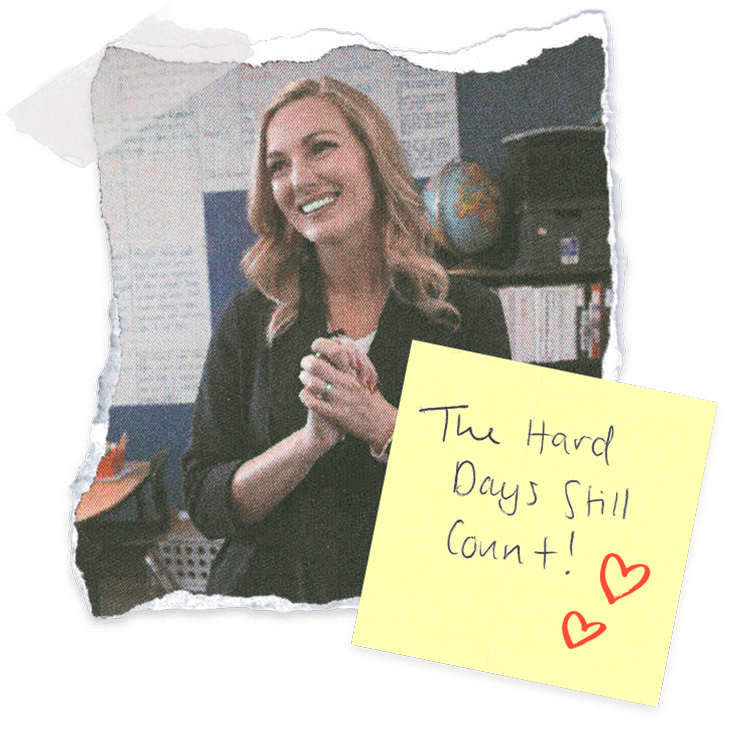
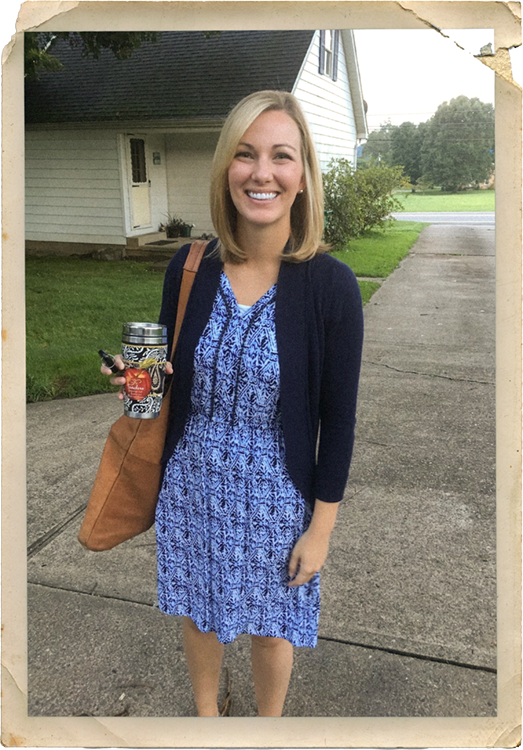
Lauren Keeling going to work as Kindergarten teacher.


Your students have also become family, in a way. You’ve loved them, been disappointed in them, and felt pride like never before. You’ve seen the good in each one — even the student who rolled himself up in the carpet around Halloween and then broke every pencil at every table because, well, you still haven’t figured that one out. But you care about them. Deeply. And you’ll carry them with you for the rest of your days. 


You’ve sat across from parents who are worried, frustrated, hopeful, and sometimes heartbroken. You’ve had hard conversations about reading levels and math gaps, about behavior that’s disruptive or concerning. You’ve learned that honesty wrapped in compassion goes a long way. You’ve said things like, “I see how hard he’s trying,” or “She’s got such a kind heart,” and you’ve meant it. You’ve learned to listen more than you speak. And you’ve realized that these conversations are sometimes more about trust than they are academics. You’re being trusted with something sacred. And when you show that you care enough to speak truth and follow it with action, you build bridges that last. 

You’ve been tempted to think you have to do it all alone. But you don’t. You have the support of a village. Scott made sure your classroom had what it needed, his humor a lifeline on days when things felt too heavy. Mary helped you survive teaching fractions, but more importantly, showed you how to lead with calm. Cheri reminded you to go home, to eat lunch, to take care of yourself — she was right. Tony showed you what it means to lead with heart. You’ll carry his lessons long after the year ends. 

The people who helped you — hug them. Thank them. Let them know that every good thing that happens in your classroom is stitched together with the threads they’ve handed you. Time with mentors is sacred; don’t rush past it. Watch them closely, learn what you can, and then trust yourself to do it your way. Their excellence is a gift, but your heart is your compass. 

You’ve had regrets, and you haven’t gotten it all right. But you’ve gotten the most important things right. You’ve loved your students and believed in them. And that has been enough. Hold tightly to hope. It’s an essential part of who you are. You owe it to yourself, but even more, your students will cling to the hope you give them. It changes lives when an adult sees something special in you. You know this. So see the special thing. Say it out loud and show the children everything you know they can be. 


Lauren, please know that I’m so proud of you. It’s a gift to look back and honor the woman you are in this season. Tell Jim thank you every chance you get, for showing up for you every day. Love your girls. Hug your mom. 

Oh, and go ahead and start drinking coffee. You really like flavored creamer. That’s the missing piece. 

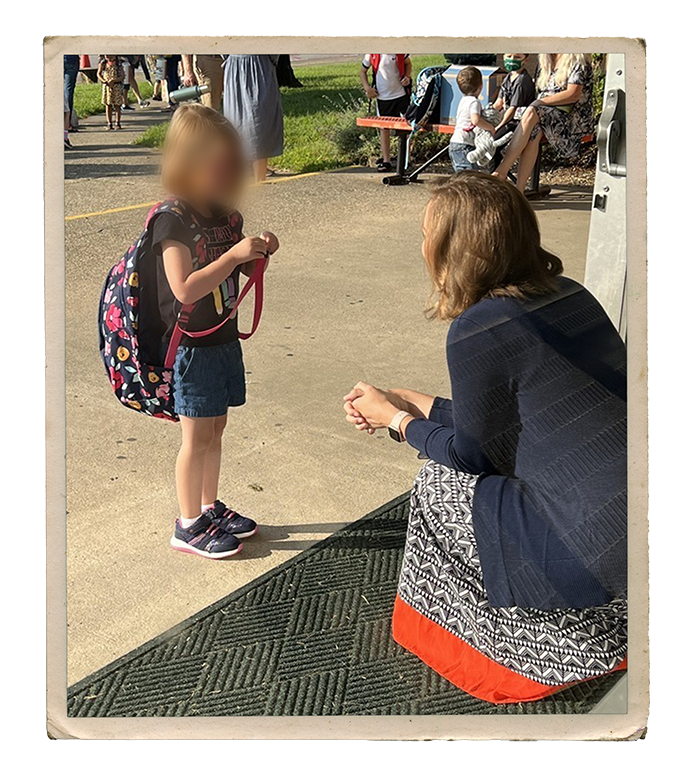
Lauren Keeling going to work as Kindergarten teacher.
Return to Collection

About the Host

Lauren Keeling is a seasoned education professional with a unique blend of experiences. A former broadcast journalist, elementary teacher, and principal, she now combines her passion for education with her love of storytelling at Imagine Learning. Above all, Lauren is a dedicated literacy advocate pursuing a doctorate in Leadership with a focus on Public and Non-Profit Organizations to further her impact on education nationwide.

Join the Club

New Admin Setting to Simplify Student Navigation 

Imagine Classroom

Site Admins can now hide the student menu in Imagine Learning Classroom 

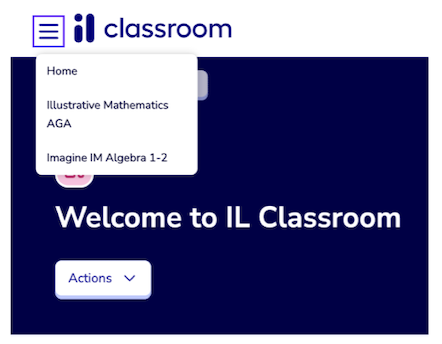
To help students stay focused on assigned lessons, Site Admins can now hide the hamburger menu in Imagine Learning Classroom. When enabled, students will only see “Home,” reducing access to unrelated content. This setting has no impact on teachers or admins and can be toggled in Site Settings. It’s a simple way to reduce distractions and streamline navigation. 

Learn More
Imagine Classroom drop down menu

Expanded Growth Reporting in Imagine Language & Literacy 

Imagine Language & Literacy

Unified progress insights across embedded and third-party assessments 

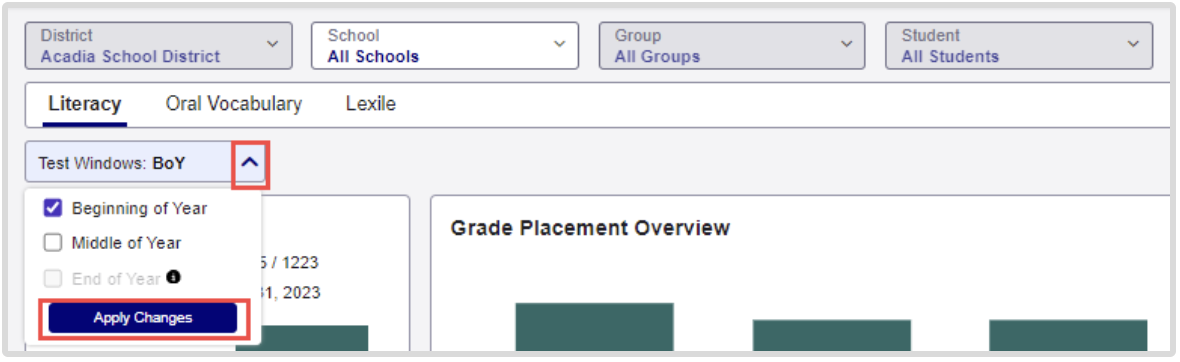
You can now see embedded assessment growth data in Imagine Language & Literacy even when grade-level overrides are in place, such as when using NWEA for some students. This update gives you a clearer, more complete picture of learning by unifying growth reporting across K–1 and upper grades, no matter your assessment setup. 

Check it Out
Imagine Language & Literacy growth report

New Student Portfolio in Imagine Language & Literacy

Imagine Language & Literacy

Easier review, better context, and faster insights into student growth 

The updated Student Portfolio offers a clearer, more efficient way to view student submissions in Imagine Language & Literacy. With improved organization, skill-level context, and simplified file management, you can quickly identify progress in reading, writing, and speaking. These enhancements help you focus on supporting growth—not sorting through files. 

Explore Now

Reading Vocabulary Now in the Activity Explorer 

Imagine Language & Literacy

Easily find, preview, and assign vocabulary activities in one place 

Reading Vocabulary activities are now available in the Activity Explorer in Imagine Language & Literacy. You can preview activities, add them to playlists, and assign them—all from one place. This update simplifies planning and saves time while helping you build vocabulary-focused lessons that support reading growth. Academic vocabulary activities are coming soon. 

Explore Now
Imagine Language & Literacy activity explorer

New Core-Aligned Pathways in Imagine Math

Imagine IM

More custom pathways now align with Imagine IM 

Imagine Math now includes even more custom learning pathways that align with the grade- and unit-level scope and sequence of Imagine IM. These pathways offer targeted, standards-based practice to support core instruction. Check back often as new pathways will be added regularly to help you meet your students’ evolving needs. 

Learn More

Filter Attendance Logs by Class in Imagine EdgeEX 

Imagine Edgenuity
Imagine EdgeEX

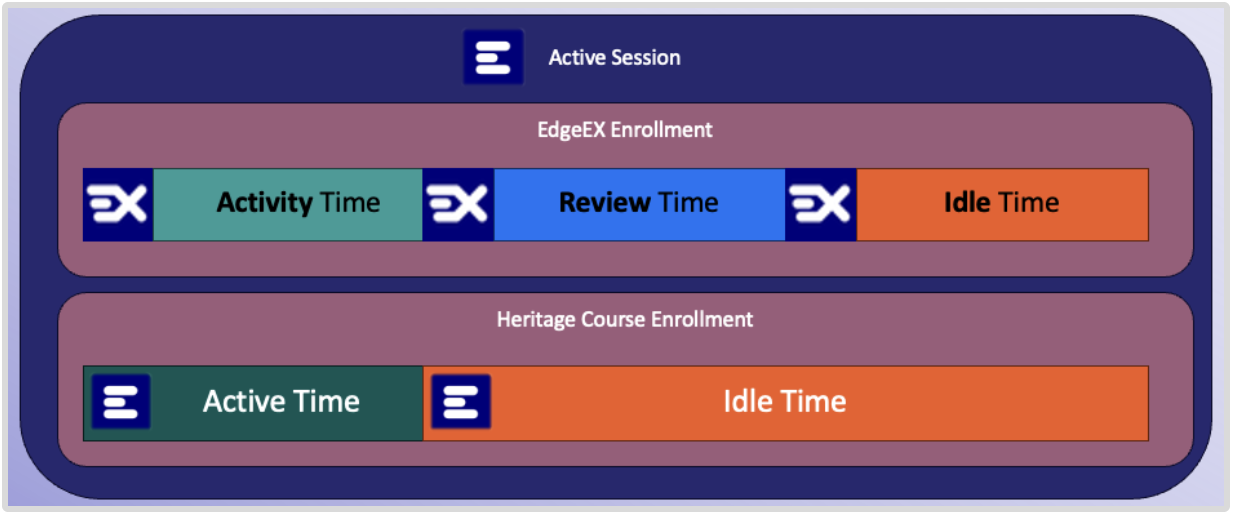
Admins can now filter session and attendance logs by class for easier tracking 

To make it easier to monitor student engagement, administrators can now filter the Attendance Log and Session Log by class in Imagine EdgeEX™. This update supports faster access to the data you need, whether you’re reviewing participation by course or following up with specific groups. 

Learn More
Imagine EdgeEX Attendance Log and Session Log

Rewriting a Literacy Crisis

Episode 2: We Picked It Ourselves

Join 600 educators in the School District of Philadelphia as they embark on a journey to rethink everything they know about teaching reading. From a teacher’s tearful realization that she had been teaching “wrong” to a deputy superintendent whose own story shows how literacy can change lives, discover the heart behind this district’s push for reform. Featuring leading voices in literacy education Nicole Ormandy and Megan Gierka.

From Imagine Learning, I’m Lauren Keeling, and you’re listening to Heart Work, an honest profile of America’s educators.

Teacher 1: It’s exciting, terrifying.

Teacher 2: Nerve-wracking.

Teacher 1: Overwhelming. There are a lot of moving parts.

Lauren: What makes it overwhelming? What makes you feel a little nervous?

Teacher 3: It’s new and it’s a lot to take in. So we just go little by little, day by day.

Lauren: Does anything make you feel excited about taking this into the classroom next year?

Teacher 4: I’m so excited that we’re going to create a school full of readers. For our kids, it’ll be life-changing.

A group of educators talking.

Lauren sits with a group of teachers as they share their thoughts on implementing new literacy practices.

In the United States, education is mostly managed at the state level — the system was literally founded on the principle of local control. And there are reasons for this.

The U.S. is vast and culturally diverse, with major differences state-by-state in demographics, economics, regional histories, and community priorities. Local control allows for decisions to be made with these contexts in mind.

But it’s also one of the reasons why change in education is slow. It’s never one change. It’s five.

With larger pedagogical shifts, progress can be even slower. And with the science of reading, it’s taken decades to reach the tipping point we’re at now, with more and more states adopting it into their reading instruction in an almost domino-like effect.

This isn’t just adopting a new curriculum; it is stripping everything we thought we knew down to the bone, fundamentally changing how teachers teach, how students learn, and how districts measure success.

But my own experience, both as a student and educator, is in a very small district. That’s why, today, I’m here in the School District of Philadelphia — the eighth-largest school district in the U.S. — to understand how a transformation like this plays out at scale.

It’s the middle of June and the beginning of summer break, and yet 600 educators have voluntarily gathered, ready, or at least willing, to rethink everything they thought they knew about teaching reading. For years, progress has been slow. And over time, it became impossible to ignore — and clear that something different was needed.

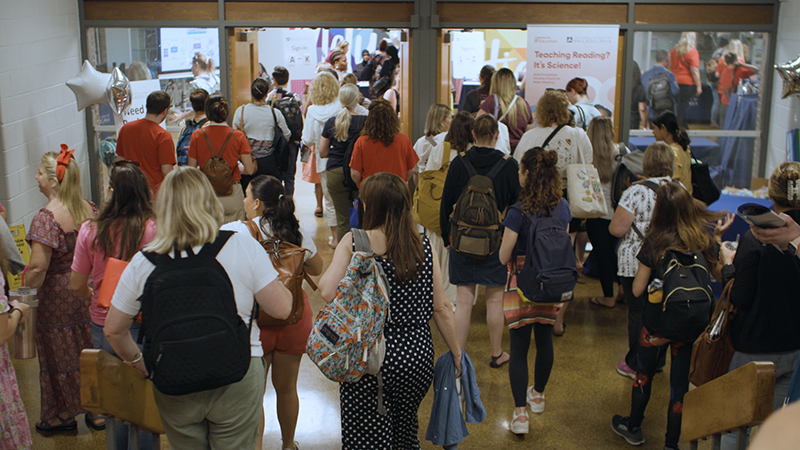
Educators and students walking in a hallway.

Educators walk through a school hallway during a break between training sessions.

Walking into the foyer of the school we were in for training, I’m shocked at the energy. I’m introduced to Antoine O’Karma. She’s the Director of Curriculum and Instruction for ELA.

I tell her I’m here to understand why they’re shifting to science of reading-aligned practices — a move toward teaching reading through systematic phonics, knowledge building, and other research-based methods — and how they’re making it work in such a big district.

She doesn’t miss a beat.

“Well,” she says, “then you have to talk to Erin Seroch.”

So I do.

Lauren Keeling: You and I were just having a conversation about just being educators and entering into a moment where we kind of realized we’d been teaching children wrong for a long time.

Erin takes me back to 2020. She was teaching second grade at Lingelbach Elementary School.

Erin Seroch: And then the pandemic hit. I listened to a podcast, Sold a Story. Bawling.

My husband’s like, “What is wrong with you?” And I’m trying to explain to him, and he’s like, “But Erin, like, you always get all distinguished on your observations and dah, dah, dah, dah, dah, and, you know, I don’t understand.”

And I’m like, “That’s great. I was doing what I thought was best, and I did that well. But I know this isn’t best for my kids, and I need to figure out what to do about it.”

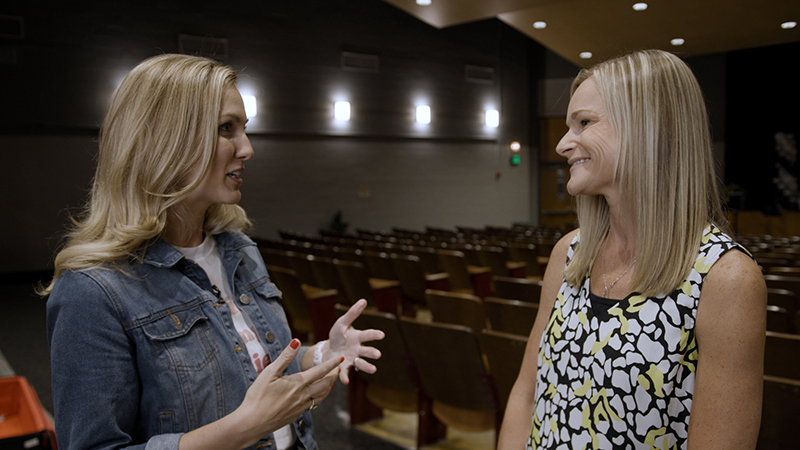
I’m struck by how similar Erin’s story is to my own. She tells me about the moment she realized just how different these instructional practices were from what she’d learned in college. That realization is what led her to enroll in a course: Pathways to Proficient Reading at the AIM Institute for Learning & Research.

Two women, Lauren and Erin, talk in a school building.

Lauren and Erin talk about their shared experiences and their paths toward evidence-based reading practices.

Erin: I saw brain MRI mappings — how kids learn how to read — and knowing that this is legit, we now have scientific evidence that this is what we need to do.

She realized that the practices backed by this research were very different from what she had learned in college.

Erin: I went back to my principal and I said, “We need to make some major changes.” We took the class together, and she was like, “OK, I get it. You’re right. I trust you. How are we going to make these changes?”

It was a good question. Adopting a new program wasn’t an option, so instead, they found ways to fold research-backed strategies into the curriculum they already had. And it worked.

Erin: Fast-forward a couple of years, and our proficiency levels went from 17% advanced or proficient on the third-grade ELA PSSA, all the way up to 79% on one school year.

Soon, people throughout the district noticed Lingelbach’s 750% growth rate. And they wanted to know what changed.

For many educators, it was data just like this that shifted their mindset. But it wasn’t just the numbers. It was the emotional piece, too. Teachers were watching their students move up to the next grade level still struggling. They were hearing their colleagues saying, “Hey, this kid is still having a hard time.” That experience pushed them to reconsider what was working.

They started reflecting on their practice. Then listening, and researching, and campaigning, and slowly, things changed.

And that is exactly what happened in Lingelbach, and it started with teachers like Erin.

My conversation with Erin led me to Megan Gierka and Nicole Ormandy. They were giving a keynote speech at the training on science of reading best practices, so I got on a call with them afterward to talk about their experience in Philadelphia and about their work supporting educators.

Lauren: So 600 teachers are learning this brand-new system; they’re learning all of these new theories, and models, and practices, and trying to get it ready to take into their classrooms in a short amount of time. Talk to me a little bit about how both of you support leaders and educators at an event of that scale.

Megan Gierka: We hardly ever walk into a room where we don’t know our audience really well. So part of our work comes in not just when we get on the stage and you hand us the microphone, but in getting to talk to those teachers and those leaders for months before we ever walk into that room — getting to know what curriculum they’re using, what assessments they’re using, what their current barriers are.

I live about an hour and a half from Philadelphia, and the schools where I taught have very different barriers than they do. So making sure to address what they’re uniquely facing when we’re in the room — but also making that research make a lot more sense.

Lauren: Let’s say that a teacher is listening to this, and he or she doesn’t have access to the two of you. Could you talk to me a little bit about how they might approach it themselves.

Nicole Ormandy: There’s unfortunately no quick fix. This is new. This is work. This is a lot of knowledge to be gained, but extremely rewarding knowledge to be gained, because what happens next, once you have that knowledge, you’re then a critical consumer.

You can be handed any curriculum, and you can evaluate: Yes, it teaches this element; no, it doesn’t; my students need it; it didn’t include it; I’m going to annotate this.

So it’s not reinventing the wheel on a strong curriculum, but it’s definitely making it extremely targeted and applicable for your audience. We can’t expect every curriculum to know every student population and to know them better — know your students better — than you.

And so that’s where that comprehensive training is preparing you to evaluate your curriculum, your assessment data, and really make use of it extremely intentionally.

Megan: Being able to discern some of the reputable and not-so-reputable resources and frameworks is so critical. So something Nicole and I live and die by is the International Dyslexia Association’s (IDA) Knowledge and Practice Standards. Nicole and I have collaborated with the IDA in the past. A lot of people think that it’s just for students with dyslexia, but really, it’s for all teachers of reading, which, by the way, is everyone. Everyone who teaches a child is a teacher of reading, writing, and literacy.

Lauren: How does the administrator or the literacy coach fit into this puzzle?

Nicole: The leaders and the administrators are driving this ship, right? It is completely unfair and ridiculous for teachers to go through training that leaders haven’t gone through, or that leaders don’t know about, or that leaders don’t understand why the teachers are doing it, and what they expect to get out of it.

Megan: Thinking to Thomas Guskey’s approach — what does it take to make an impact in a system? Student outcomes are a level five. So what we saw when we were in Philly was that level one, initial reactions to learning or to a system change.

You start to see, over time and through the years, some of those higher levels of transfer to practice and student outcomes. I think sometimes leaders get antsy because they don’t see them in three weeks or three months, and they’re quick to abort mission when really it is a process to even get to those enhanced outcomes.

In 2013, Mississippi passed a law requiring schools to use research-backed instruction and materials. It was a desperate attempt to improve their reading scores. At the time, they had the lowest percentage of fourth-grade students reading on grade level.

Jump forward to 2019, and Mississippi made the most gains in fourth-grade reading in the country. The results speak for themselves; they’re remarkable.

But it would definitely be an oversimplification to say it’s all due to the introduction of new legislation. It took an incredible collective effort and a clear strategy that district leaders, educators, and parents equally bought into. Their success inspired other districts to adopt their own strategies, like the ones currently underway in the School District of Philadelphia.

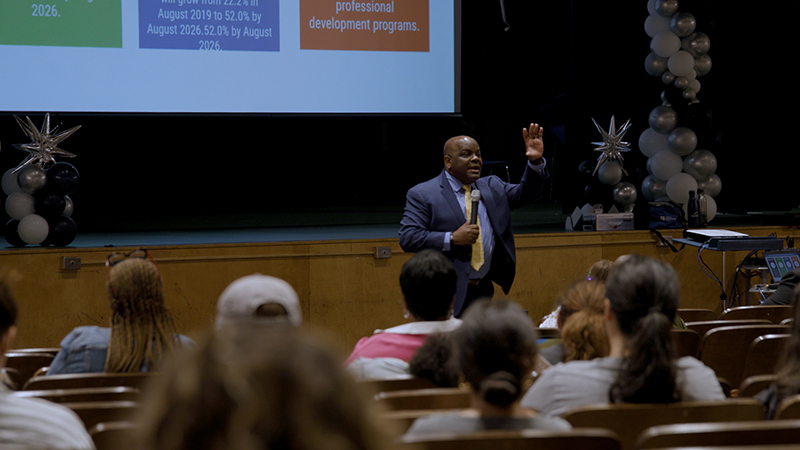
A man dynamically talks to a seated group of people.

Dr. Dawson speaks to an audience during his keynote presentation.

Dr. Dawson, the district’s deputy superintendent, is helping lead this strategy. He is also attending the training event to deliver a speech, and I catch him right after to talk.

Lauren: Dr. Dawson, your keynote speech was incredibly inspiring and spoke beautifully to the mission of the School District of Philadelphia. Why is this important?

Dr. Dawson: It’s so important that our students are able to read — and read at high levels. Not so much because of the foundational literacy pieces — but what does that mean for them in their future when they turn that tassel, as I say, and graduate 12 years later? The question we need to ask ourselves is, “Do they have the skills to be able to be successful in life, that will set them up for a limitless future?”

I’ve been on both sides. I’ve learned as a student using foundational literacy skills — or structured literacy — and then I’ve also been trained in whole language.

And what we see is that our students, by the time they get to high school, still struggle with the ability to effectively decode words. They don’t have the foundational strategies to attack that word, and that then creates a problem with comprehension.

And what this will do — through structured foundational literacy skills, phonemic awareness, phonics, fluency, vocabulary, the automaticity that comes with fluency that builds comprehension — is allow them to take those skills and tools and start to read more advanced texts, moving from learning to read to reading to learn.

Dr. Dawson shows his students exactly who he is, where he comes from, and what he overcame.

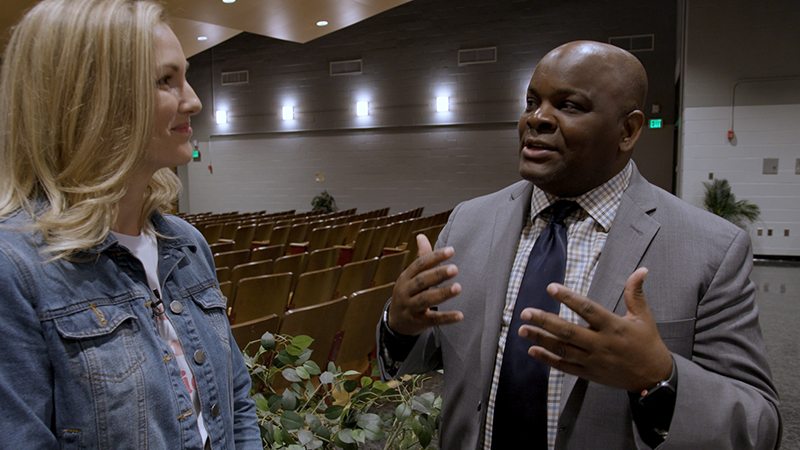
A woman, Lauren, talks to a man, Dr. Dawson, in an empty auditorium.

Lauren talks with Dr. Dawson after his keynote presentation about the importance of literacy.

Dr. Dawson: I, myself, grew up in severe poverty. I experienced homelessness — eating out of trash cans, not knowing, and sleeping on porches — but one thing that I got was foundational skills in reading that set me up. I was able to read books that took me on journeys beyond where I was living every day and showed me a world that was bigger than I ever could have imagined.

And that inspired me and motivated me that I can see more and do more and want to see more. And because of the foundational skills that I received, I was able to go off and be where I am today as a deputy superintendent of academic services.

In the School District of Philadelphia, our goal is to give the students the skills and tools they need to be successful, so that they too can have that future — just like I have.

It’s late in the day, and we’re all feeling it. But there’s one more person I need to speak with to fully understand how a district of this size navigates a change like this: Antoine.

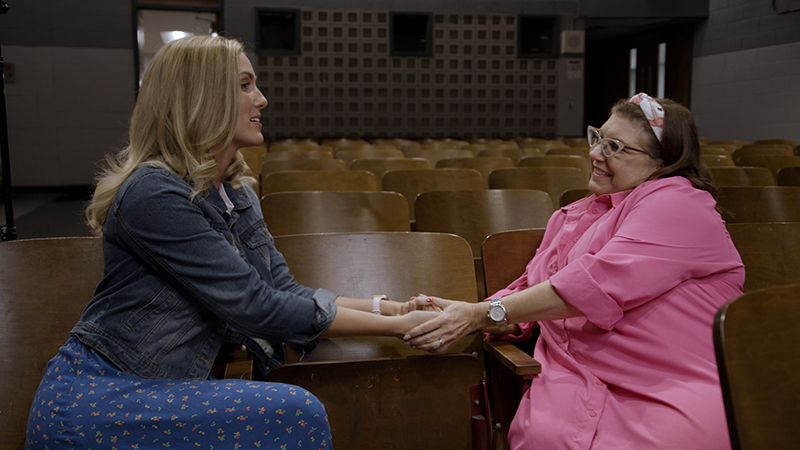
Two seated women hold hands in an empty school auditorium.

Lauren and Antoine sit in an auditorium, smiling and holding hands in a moment of shared emotion.

She had been one of the voices pushing hardest for change, and she’d helped put together this massive training session.

Lauren: So in designing this week and making the commitment to change and in working to support educators, how are you helping them learn what the science of reading really feels like?

Antoine O’Karma: We’re not just starting this week, right? We’ve been working with teachers for four years now. And I think showing connections, right? Not saying, “OK, everything you’ve been doing is wrong. It’s bad,” right? We have such smart teachers, such veteran teachers, and it’s not like throwing the baby out with the bathwater, right?

Antoine emphasizes that the training must go beyond focusing solely on pedagogy. Teachers need to leave with a clear understanding of how the research translates into practical application and how new instructional strategies build on their existing knowledge.

She acknowledges that the change won’t be easy or quick — but that ultimately, it has to happen.

Antoine: But if we can show through data that this is why we’re doing it. We cannot be happy with 38% of our children reading on grade level.

Lauren: I wonder what you would say to someone who is going to tell you that the School District of Philadelphia can’t make this change — can’t turn it around, can’t change those scores.

Antoine: I would say, let’s look at our data. Let’s look at how our data has changed. The data doesn’t lie. We’ve had some amazing results for schools and teachers who really bought in, honed their knowledge, and are committed to this work.

As educators, we often want to see results immediately, but that’s not how it works.

It takes at least three years to fully implement any kind of change practice and see results. And the first year is always the worst. That’s just the truth.

We also have to acknowledge that research is not fixed. It doesn’t point to one answer and say, “This is it forever.” And that doesn’t mean the research is wrong or ineffective, quite the opposite — that’s the point of research: To continue to learn.

In the School District of Philadelphia, they’re in it for the long run.

But this is not my biggest takeaway from my time there. What is, is how influential teachers were in starting the change movement and how deeply they believed in it — and that is really crucial to finding success when making real change in the classroom.

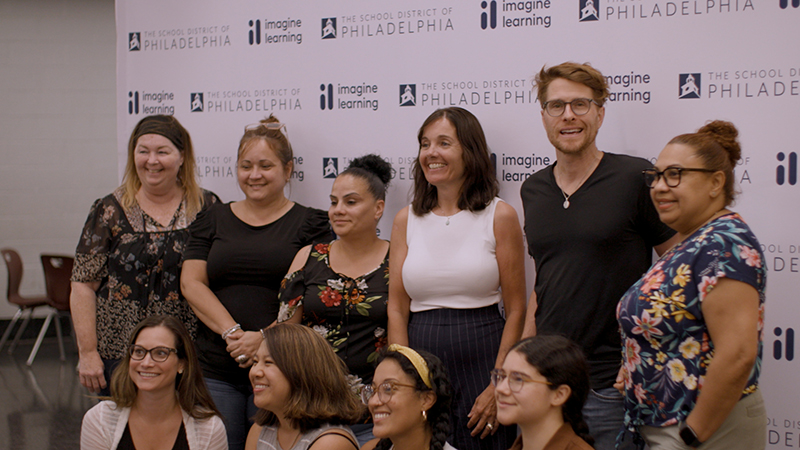
A group of educators pose for a photo in front of a backdrop.

A group of educators pose for a photo.

Megan: Frederick Douglass said that once you learn to read, you will be forever free.

If we can give this gift to our children, they will have lifelong success as a result of that precious school year we had with them.

Nicole: You can do this. You can do this. It matters. Don’t be afraid. Be empowered. Knowledge is power, right? So get in there, get your hands dirty, and learn this work. Start making the change, because you deserve it. Your kids deserve it. And, like Megan said, it’s freedom.

Next time, I’ll be heading back to Pendergast Elementary School District to see the culmination of three years’ worth of dedication to improving reading scores. I’ll also be talking to education writer Natalie Wexler about the critical importance of knowledge building.

Natalie Wexler: We have to stop seeing reading as separate from learning — than the content areas — as if reading and writing both are separate from each other. They really are not. We know that when kids write about what they’re learning, it boosts their reading comprehension. It deepens their learning. These things are all connected.

All that and more on the next episode of Heart Work.

Want to put faces to the voices you heard today? Join me on YouTube at Imagine Learning to meet the educators featured in this podcast, and don’t forget to check out my reading list linked in the description, along with a link to Megan and Nicole’s podcast, Reading Recess.

This episode of Heart Work is produced by Justyna Welsh, Anise Lee, Danny McPadden — and me. Editing and mixing by Fraser Allan. Our recording engineer is Dan Victory. Our set supervisor is Tyler Kavanaugh. Artwork by Ellen Forsyth. Our executive producer is David McGinty. Music is from Universal Production Music. Special thanks to the School District of Philadelphia, Erin Seroch, Dr. Jermaine Dawson, and Antoine O’Karma for welcoming us at the Summer Institute, Megan Gierka and Nicole Ormandy, and the educators who spoke with us for this episode.

Heart Work is brought to you by Imagine Learning.

[00:00] Introduction

[00:47] The challenge of change in education

[02:07] Arriving at the School District of Philadelphia’s Summer Institute

[02:58] Erin’s story

[04:58] The role of educators in inspiring change

[05:35] Supporting teachers at scale

[09:16] Learning from Mississippi

[10:18] Dr. Dawson on how literacy transforms lives

[12:30] Sustaining the work

[14:41] Final thoughts

Return to Collection

About the Host

Lauren Keeling is a seasoned education professional with a unique blend of experiences. A former broadcast journalist, elementary teacher, and principal, she now combines her passion for education with her love of storytelling at Imagine Learning. Above all, Lauren is a dedicated literacy advocate pursuing a doctorate in Leadership with a focus on Public and Non-Profit Organizations to further her impact on education nationwide.
An image of Lauren Keeling.

Join the Club